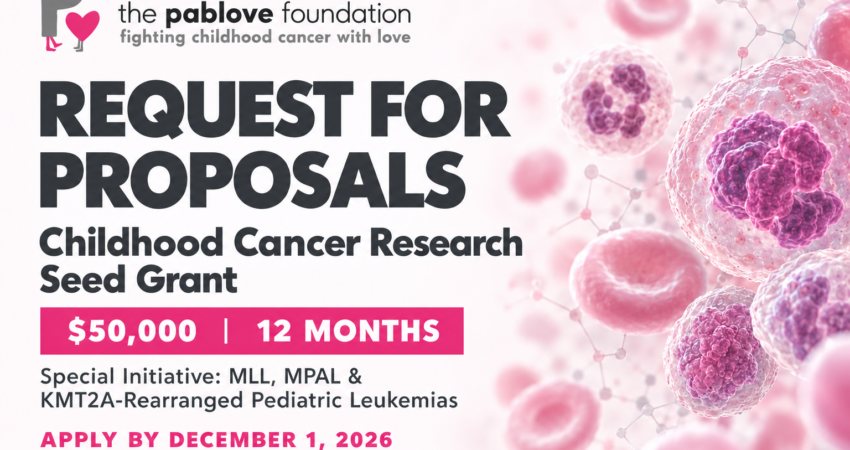
FUNDING OPPORTUNITY: Advancing Pediatric Neuroblastoma and Related Neuroblastic Tumor Research
CHILDHOOD CANCER RESEARCH SEED GRANT
Letter of Intent (LOI) Application Guidelines
Special Initiative: Advancing Pediatric Neuroblastoma and Related Neuroblastic Tumor Research
$50,000 award | 12-month period | LOIs due December 15, 2026
Who We Are
The Pablove Foundation invests in underfunded, cutting-edge pediatric cancer research and improves the lives of children living with cancer through the arts. We work toward better, less toxic treatments and a cure, while helping them experience creativity, joy, and the freedom to be kids during treatment.
What We Fund: This Opportunity
In partnership with private family donors, The Pablove Foundation invites innovative, high-impact research proposals that advance the understanding, diagnosis, and treatment of pediatric neuroblastoma and related neuroblastic tumors.
This $50,000, one-year seed grant supports a novel, standalone pediatric research study or the generation of critical proof-of-concept data. The goal is to help investigators establish a foundation for larger national or federal funding opportunities, including NIH/NCI and other major research funding programs.
While this initiative prioritizes neuroblastoma research, we are particularly interested in projects that explore the intersection of tumor biology, neuroimmunology, and immune-mediated neurological complications, including potential connections to Opsoclonus-Myoclonus Syndrome (OMS).
Research that advances our understanding of the relationship between pediatric cancer and the immune system is encouraged, even if the proposed study does not directly investigate OMS.
Research Priorities
We welcome proposals addressing, but not limited to, the following areas:
1. Neuroblastoma Biology and Therapeutic Innovation
- Investigate the molecular, genetic, and epigenetic mechanisms driving neuroblastoma development and progression.
- Identify novel therapeutic targets and approaches to overcome treatment resistance or relapse.
- Explore innovative treatment strategies, including targeted therapies and combination approaches, with an emphasis on reducing toxicity in children.
2. Neuroimmunology and Tumor-Immune Interactions
- Investigate how neuroblastoma interacts with the immune system and influences immune responses.
- Explore immune-mediated mechanisms that contribute to neurological complications associated with pediatric cancer.
- Study the role of autoimmunity, neuroinflammation, and immune cell signaling in cancer-related neurological conditions.
- Investigate how the immune response to neuroblastoma may contribute to conditions such as OMS.
3. Related Neuroblastic Tumors and Shared Biological Mechanisms
- Explore the biology and treatment of other pediatric neuroblastic tumors, including ganglioneuroblastoma and ganglioneuroma.
- Investigate shared molecular, genetic, or immunological pathways across neuroblastic tumors.
- Identify research opportunities that may advance understanding of both tumor development and associated neurological complications.
4. Translational Research and Improved Outcomes
- Develop innovative approaches to earlier diagnosis, disease monitoring, and treatment response.
- Investigate biomarkers that may help identify children at risk for neurological complications or treatment-related toxicity.
- Advance research that could lead to better long-term neurological, developmental, and clinical outcomes for children living with cancer.
Innovative proposals outside these specific areas will also be considered if they demonstrate a clear pediatric oncology focus and relevance to this initiative.
Eligibility, Funding & Review
Who Is Eligible to Apply?
- Applicants must hold a Ph.D., M.D., or equivalent degree and be affiliated with an accredited academic medical center or pediatric research institution.
- Projects must have a clear pediatric oncology focus relevant to neuroblastoma, related neuroblastic tumors, or associated tumor-immune and neuroimmune mechanisms.
- Early-career investigators, including postdoctoral fellows and junior faculty, are encouraged to apply.
- Established laboratories proposing innovative approaches or entering this research area are also welcome.
Additional Application Policies
- International applicants and institutions are welcome; there is no residency requirement.
- Past Powered by Pablove grant recipients are not eligible to apply.
- Only one LOI may be submitted per principal investigator. Multiple applications from a single institution are permitted.
Budget & Funding Guidelines
Total Award: $50,000 for a 12-month project period.
Indirect Costs: 0%. Institutions must waive all indirect, overhead, and facilities and administrative (F&A) charges. No additional indirect-cost payment will be provided; 100% of the award must support direct research costs.
Direct Costs: The budget should support the proposed research, including reagents, sequencing fees, laboratory supplies, and technician or postdoctoral salary support directly related to the project.
The Review Process
Applicants must first submit a Letter of Intent (LOI) through ProposalCentral. The Pablove Foundation Scientific Advisory Committee conducts a competitive peer review. A limited number of the most meritorious LOIs will be invited to submit full research proposals. LOI applicants do not receive review critiques.
Full proposals are evaluated using standard NIH scoring guidelines, with emphasis on innovation, approach, feasibility, and relevance to Pablove’s mission and this initiative. Full-proposal applicants receive review critiques.
The Pablove Foundation Board of Directors makes final funding decisions.
Full-proposal deadlines, award notification, and the anticipated project start date will be communicated separately.
How to Submit Your LOI
LOI Deadline: December 15, 2026
Applications will be submitted through ProposalCentral at proposalcentral.altum.com. Applicants may create an account or log in to access the Childhood Cancer Research Seed Grant opportunity for this initiative.
LOI Checklist
- Applicant and institution: Complete the title page, principal investigator profile, institutional information, and any required PI data fields. Review the program guidelines and available templates. Grant collaborators access if needed.
- Lay summary: Up to 1,500 characters, including spaces.
- Scientific summary: Up to 8,000 characters, including spaces. Include specific aims; rationale and approach; innovation, potential impact, and future patient benefits. Explain how the project addresses this initiative. Select relevant keywords.
- Budget summary: Request no more than $50,000 for 12 months, with 0% indirect costs.
- Other support: Provide current and pending support as requested in the application.
- Required attachments: Relevant references supporting the hypothesis (PDF, maximum one page) and an NIH biosketch (PDF). Graphs or figures are optional (PDF, maximum one page).
- Validate and submit: Complete all required fields, run the application validation, and submit the LOI. Retain the automatic submission confirmation email.
Follow all character limits, page limits, and attachment requirements shown in the current ProposalCentral application.
Questions & Assistance
Grant process: [email protected]
Technical assistance: Use the support options provided within ProposalCentral.
The Pablove Foundation’s Childhood Cancer Research Seed Grants support innovative, early-stage pediatric cancer research with the potential to advance scientific understanding and improve outcomes for children living with cancer.
Next Post
Latest Posts